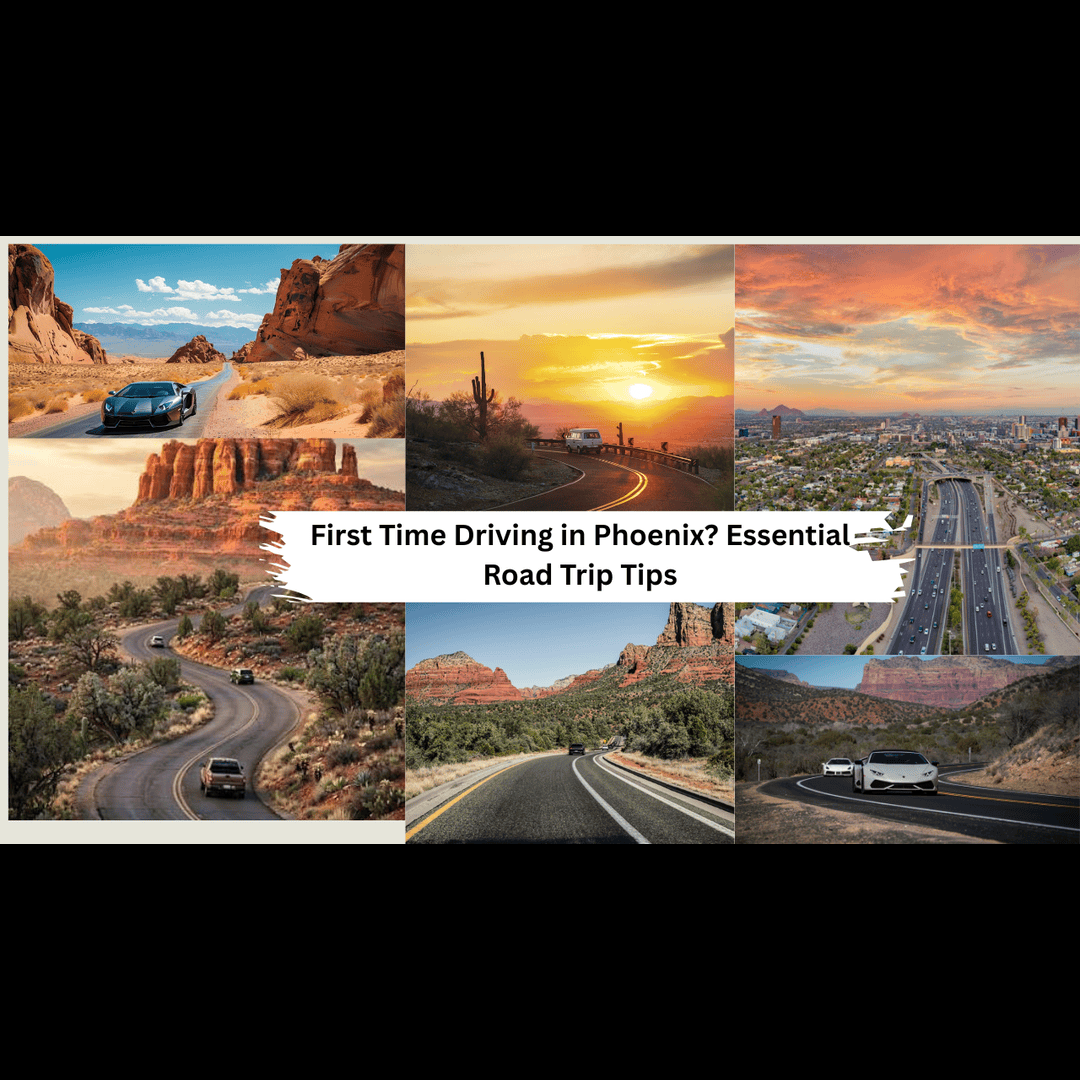
Driving in Phoenix is easier than it looks once you know a few local rules. The streets follow a simple numbered grid, the freeways get busy at set hours, and summer brings extreme heat, dust storms, and flooded roads. Most first-time trouble comes from small things, like typing “Street” instead of “Avenue” or joining the I-10 at the height of rush hour. These Phoenix driving tips help you avoid those mistakes before they cost you time.
The seven tips below cover freeway timing, Arizona driving laws, and desert safety. Whether you’re picking up a compact at Sky Harbor or booking an exotic car rental Phoenix for a special trip, the same basics apply. You’ll also get realistic road trip drive times and a quick checklist for inspecting your rental before you leave. Here is what to know before you start.
1. Phoenix Grid and Freeways Fit Together
Most surface streets in Phoenix run straight north to south or east to west. Central Avenue is the dividing line between east and west. Numbered Streets sit east of Central, and numbered Avenues sit west of it, so 7th Street and 7th Avenue are on opposite sides of downtown Phoenix. Washington Street splits north and south addresses. Grand Avenue is the main exception, cutting diagonally to the northwest.
That system makes Phoenix easy to read, but it also creates the most common visitor mistake. A GPS that autofills the wrong one can send you miles off course, so check whether your destination says “St” or “Ave” before you start driving.
The Freeways You’ll Actually Use
- I-10: runs east to west through downtown Phoenix and is your route to Tucson in one direction and California in the other.
- I-17: heads north from central Phoenix toward Sedona and Flagstaff, and it carries most road trip traffic.
- Loop 101: circles the north, west, and east sides of the Valley and is the usual link between Phoenix and Scottsdale.
- Loop 202: covers the East Valley and, through the South Mountain Freeway, the southwest side of Phoenix.
- SR 51 and US 60: SR 51 runs north from downtown, and US 60 heads east toward Mesa and the Superstition Mountains.
Signs often show a freeway’s name instead of its number, such as Piestewa for SR 51 or Red Mountain for part of Loop 202. Learn both before you rely on a quick glance at an overhead sign. Locals also add “the” to numbers, so “take the 101” just means Loop 101.
If you plan to spend a few days in central Phoenix, our guide to the best neighborhoods to drive in Phoenix shows which areas suit a relaxed drive and where traffic and parking get tight.
2. Time Your Drives Around Rush Hour and Fast Freeway Merges
The Arizona Department of Transportation (ADOT) restricts HOV lanes from 6 a.m. to 9 a.m. and 3 p.m. to 7 p.m., Monday through Friday, and those windows match the heaviest Phoenix traffic. If you can schedule airport runs, meetings, and day trip departures outside them, you’ll spend far less time in stop-and-go traffic.
During restricted hours, HOV lanes are limited to vehicles with two or more people, plus motorcycles and buses. Outside those hours, and all weekend, anyone can use them. HOV lanes are marked with a white diamond and solid white lines, so enter and exit only where the markings allow.
Merging and Exits
Phoenix freeway traffic often moves faster than first-time drivers expect, and on-ramps can be short. Use the full ramp to build speed, signal early, and wait for a green light where ramp meters are active. Watch overhead signs well ahead of your exit, because some interchanges split lanes in ways that are hard to fix at the last second. If you miss an exit, take the next one. The grid makes rerouting simple.
Sun Glare on East-West Roads
Because so many Phoenix roads run due east or west, the sun can sit directly in your line of sight shortly after sunrise and before sunset. In winter, those low-sun hours overlap with the evening commute. Keep sunglasses within reach, clean the windshield inside and out, and leave extra space behind the car ahead.
Wrong-Way Drivers at Night
Wrong-way crashes on divided highways are a real concern in Arizona, and ADOT warns that many wrong-way drivers are impaired, which makes them unpredictable. ADOT runs a thermal camera detection system on I-17 between I-10 and Loop 101, and overhead signs will warn “Alert, wrong-way driver ahead” when one is reported. If headlights come toward you on your side of the road, ease off the gas, make sure no vehicle is beside you, steer away, and once you’re somewhere safe, call 911.
3.Driving Laws Visitors Most Often Miss
Most traffic rules in Arizona will feel familiar, but a few catch out-of-state drivers every year. These are the ones worth reading twice before you start driving around Phoenix.
- Hands-free law: Arizona law (A.R.S. 28-914) bars drivers from holding or supporting a phone while driving, though a mounted phone for navigation and hands-free calls is allowed.
- Move Over law: when you approach any stopped vehicle showing flashing or hazard lights, move to a lane that is not next to it, or slow down if changing lanes isn’t safe (A.R.S. 28-775).
- Speed cameras: Phoenix restarted photo speed enforcement in 2026 with 17 mobile cameras that rotate between high-crash corridors and school zones, and several nearby cities use photo enforcement too.
- Visitor licenses: a valid license from your home state or country lets you drive in Arizona as a visitor, and an International Driving Permit is recommended for foreign licenses but not required by the state.
Photo enforcement rules may change. Arizona voters decided Proposition 319 on the November 3, 2026 ballot, which would limit how cities use these cameras. Whatever the outcome, posted speed limits still apply, and police enforce them in person.
Rental companies can set their own rules on top of state law, such as minimum ages, insurance requirements, or extra documents for international drivers. Confirm those before you arrive, not at the counter.
4. Treat Phoenix Heat as a Driving Hazard
ADOT notes that desert temperatures can reach or pass 100 degrees every day in summer. That heat drains batteries, raises tire pressure, and makes a simple breakdown dangerous, especially if you try to change a tire or wait outside the car for help.
Before any drive in hot months, ADOT suggests filling your tank and keeping it about three-quarters full, testing the battery, topping off coolant, checking tire pressure, and making sure the A/C works. Pack plenty of water for every passenger, snacks, a fully charged phone, sun protection, a first-aid kit, and any prescription medication.
Heat also changes how you handle the car itself. Steering wheels, leather seats, and metal seatbelt buckles get hot enough to hurt, so use a sunshade and park in covered spots when you can. Never leave a child or pet in a parked car, even for a quick stop. ADOT also advises against parking on dry grass, because heat from under a vehicle can start a brush fire.
If your car does quit, pull fully off the road, turn on your hazard lights, and raise the hood so other drivers and responders know you need help. Stay hydrated and call the number on your rental agreement. Our guide on what to do if your rental car breaks down covers the steps after that, including documenting the problem for the rental company.
5. What to Do in Monsoon Season
The National Weather Service defines Arizona’s monsoon season as June 15 through September 30. Storms can build in the afternoon with little warning, bringing heavy rain, strong winds, and dust storms that can drop visibility to zero within minutes. Dust storms are most common in monsoon season, but ADOT notes they can appear at any time of year.
What to Do in a Dust Storm
ADOT’s “Pull Aside, Stay Alive” guidance gives clear steps if you can’t avoid the storm:
- Don’t drive into a dust storm if you can see it ahead.
- Check the traffic around you and begin slowing down.
- Exit the highway if you can, and if not, pull completely off the pavement rather than stopping in a travel lane or the emergency lane.
- Turn off all vehicle lights, including hazard flashers, set the parking brake, and take your foot off the brake pedal.
- Stay in the vehicle with your seat belt fastened until the storm passes.
Turning off your lights feels wrong, but there is a reason for it. In thick dust, drivers behind you may follow your taillights and assume you are still moving in the lane. Without lights, they are less likely to steer straight into your parked car.
If you’re driving to Tucson, the I-10 stretch between Eloy and Picacho Peak is a known trouble spot, which is why ADOT built a dust detection and warning system there.
Flooded Roads and Washes
Many desert roads dip through washes that fill fast during storms. Never drive around a barricade or into moving water you can’t see the bottom of. Arizona’s so-called “stupid motorist law” (A.R.S. 28-910) makes a driver who goes around flood barricades and gets stranded liable for the cost of the emergency response, up to $2,000 per incident, and the law allows insurance policies to exclude that cost. Damage to a rental car from flood water is a separate problem entirely.
Before you leave, check road conditions on ADOT’s az511.gov site or the AZ511 app, and look at the National Weather Service forecast for your route.
6. Plan Phoenix Road Trips With Realistic Drive Times
Most day trips start on I-17 north or I-10 south, and distances on a map can make them look shorter than they feel. Elevation changes, weekend traffic, and construction all add time. The table below gives a realistic starting point.
| Destination | Main route from Phoenix | Typical drive | What to plan for |
| Sedona | I-17 north to SR 179 | About 2 hours (roughly 113 miles) | Roundabouts on SR 179 and busy weekend traffic |
| Flagstaff | I-17 north | About 2 hours | Heavy weekend traffic, high elevation, and winter snow |
| Grand Canyon South Rim | I-17, I-40 west, then AZ 64 | 3.5 to 4 hours (about 231 miles) | Long stretches between towns and cold winter weather |
| Tucson | I-10 east | About 2 hours | Dust-prone stretch between Eloy and Picacho Peak |
The I-17 is the road to watch. An ADOT official has described roughly a 50 percent jump in both weekend traffic and weekend crashes on this corridor. Northbound traffic builds on Fridays and Saturdays, and southbound traffic back into Phoenix builds on Sundays. Leaving early, or returning on a weekday, saves real time.
Elevation also changes the weather. Flagstaff sits at about 7,000 feet, so a warm winter day in Phoenix can mean snow and ice two hours north. Pack a jacket, check conditions before you go, and fill up in larger towns like Flagstaff or Williams before heading to the Grand Canyon. Cell service can fade on rural highways, so download offline maps too.
For routes worth building a trip around, our list of scenic drives across Arizona covers roads like Oak Creek Canyon and Salt River Canyon, with notes on timing and fuel.
7. Pick Right Rental Car and Inspect It Before You Drive
Renting a car in Phoenix often starts at Sky Harbor’s Rental Car Center, a separate building on Sky Harbor Circle South. The free PHX Sky Train connects it to the terminals and runs 24 hours a day, so budget extra time for that ride on arrival and when you return the car.
The right car depends on your route. Two people sticking to city streets and resort drives will enjoy a sports car, while a group with luggage heading to Sedona or the Grand Canyon will be happier in something larger. Our comparison of a sports car or an SUV for a Phoenix trip walks through that decision by passengers, bags, season, and road type.
Driving a Luxury or Exotic Rental in Phoenix
Exotic cars bring a few extra considerations. Many sit low to the ground, so take steep driveways, speed humps, and parking ramps slowly and at an angle. Avoid unpaved roads, and read your rental agreement, since rental terms often restrict dirt roads and cap daily mileage. Mileage allowances usually vary by vehicle, so confirm yours before you plan a long drive.
If your plans mix highway miles with luggage and the occasional rough driveway, a performance SUV such as the Lamborghini Urus gives you more ground clearance and cargo space than a two-seat supercar. Premier Luxury Club asks renters for a valid driver’s license, proof of full-coverage auto insurance, and a security deposit, and it can arrange delivery to hotels, homes, and the Sky Harbor area.
Before you drive away, walk around the car and photograph every panel, wheel, and the windshield. Record the fuel level and mileage, and test the A/C before you need it. Our checklist of things to check when renting a car covers the full inspection.
Parking Around Phoenix
The City of Phoenix runs about 2,000 parking meters in downtown, uptown, the capitol area, and around Phoenix College. You can pay with the ParkMobile app, most metered spaces allow one to two hours, and on-street meters are free overnight from 10 p.m. For longer stops or a low, valuable car, a garage or valet stand is usually the safer choice.
Mistakes First-Time Phoenix Drivers Make
- Mixing up Street and Avenue: a single wrong letter in your GPS can put you on the other side of town.
- Driving in the 3 p.m. to 7 p.m. window: weekday afternoons are among the busiest times on Phoenix freeways.
- Holding a phone for directions: Arizona’s hands-free law applies to navigation too, so mount the phone before you start driving.
- Underestimating desert distances: leaving with a low tank in summer heat turns a minor delay into a serious problem.
- Driving into dust or around flood barricades: both can turn deadly, and the second can come with a rescue bill.
- Booking the wrong car for the route: a low-slung supercar and a dirt road to a trailhead are a poor match.
Phoenix Road Trip Checklist
- Route and timing: check az511.gov and plan departures outside weekday rush hours.
- Weather: look at the National Weather Service forecast, especially from June 15 to September 30.
- Fuel: start with a full tank and keep it above three-quarters in summer.
- Water and supplies: pack water for everyone, snacks, sun protection, and a first-aid kit.
- Phone: charge it, mount it, and download offline maps for rural stretches.
- Documents: carry your license, proof of insurance, and the rental agreement.
- Rental terms: confirm mileage limits, road restrictions, and the roadside help number.
- Condition photos: record the car’s exterior, wheels, fuel level, and odometer before leaving.
Conclusion
Driving around Phoenix gets simple once the basics click: read the grid, stay out of weekday rush hours, follow the hands-free and Move Over laws, and respect the heat, dust, and flooded washes that make the desert different. Plan road trips with honest drive times and the right car for the route, and the rest of the Valley opens up quickly.
If you’d like the car brought to your hotel or home instead of a trip to the rental counter, Premier Luxury Club offers luxury and exotic rentals across Phoenix and the surrounding area. Tell the team where you’re headed, and they can help you choose a car that fits the road.
FAQs
Is it hard to drive in Phoenix for the first time?
Not usually. The grid layout and wide roads make Phoenix easier to read than many large cities. The main challenges are fast freeway traffic, rush hour congestion, and summer weather, all of which get easier with a little planning.
What are the worst times to drive in Phoenix?
Weekdays from 6 a.m. to 9 a.m. and 3 p.m. to 7 p.m. are the busiest, which is why ADOT restricts HOV lanes during those hours. Weekends can also be heavy on I-17, northbound on Fridays and Saturdays and southbound on Sundays, as people travel to and from northern Arizona.
Can I drive in Arizona with an out-of-state or foreign license?
Yes. Visitors can drive in Arizona with a valid license from another state or country. ADOT recommends an International Driving Permit alongside a foreign license because it is printed in English, and rental companies may ask for more documents.
Are there toll roads in Phoenix?
No. Phoenix-area freeways do not charge tolls, and ADOT does not use congestion pricing on them. HOV lanes are free as well, but they have occupancy rules on weekday mornings and afternoons.
Can I take an exotic rental car on a road trip to Sedona?
Usually, yes, since the main route is paved freeway and state highway. Check your rental agreement for mileage limits and road restrictions first, and stay off dirt roads and steep, rough trailhead lots. If you’re carrying luggage or several passengers, a luxury SUV is often the more practical choice.